

After machinery has been in operation for many years, one of the most common issues in manufacturing plants is the need to replace existing machine knives.
For some equipment, replacement parts are still available from the original manufacturer. However, in many cases, the machinery has been in service for years, the original model has been discontinued or specifications have changed, and even the original knife drawings may no longer be available. In such situations, the only thing left on site may be a used knife.
“Can a replacement knife still be manufactured if we only have the old knife and no drawing?”
This is one of the most common questions customers ask when requesting custom industrial knives.
In fact, the absence of a complete drawing does not necessarily mean that the specifications cannot be determined. If sufficient information is available—such as an existing knife sample, photographs, dimensions, or machinery information—it can usually be used as a reference for further specification verification.
However, manufacturing a custom machine knife is not simply a matter of measuring its dimensions. The machine on which the knife is installed, the material being processed, and whether the knife is used for cutting, punching, or another operation can all affect the final specifications.
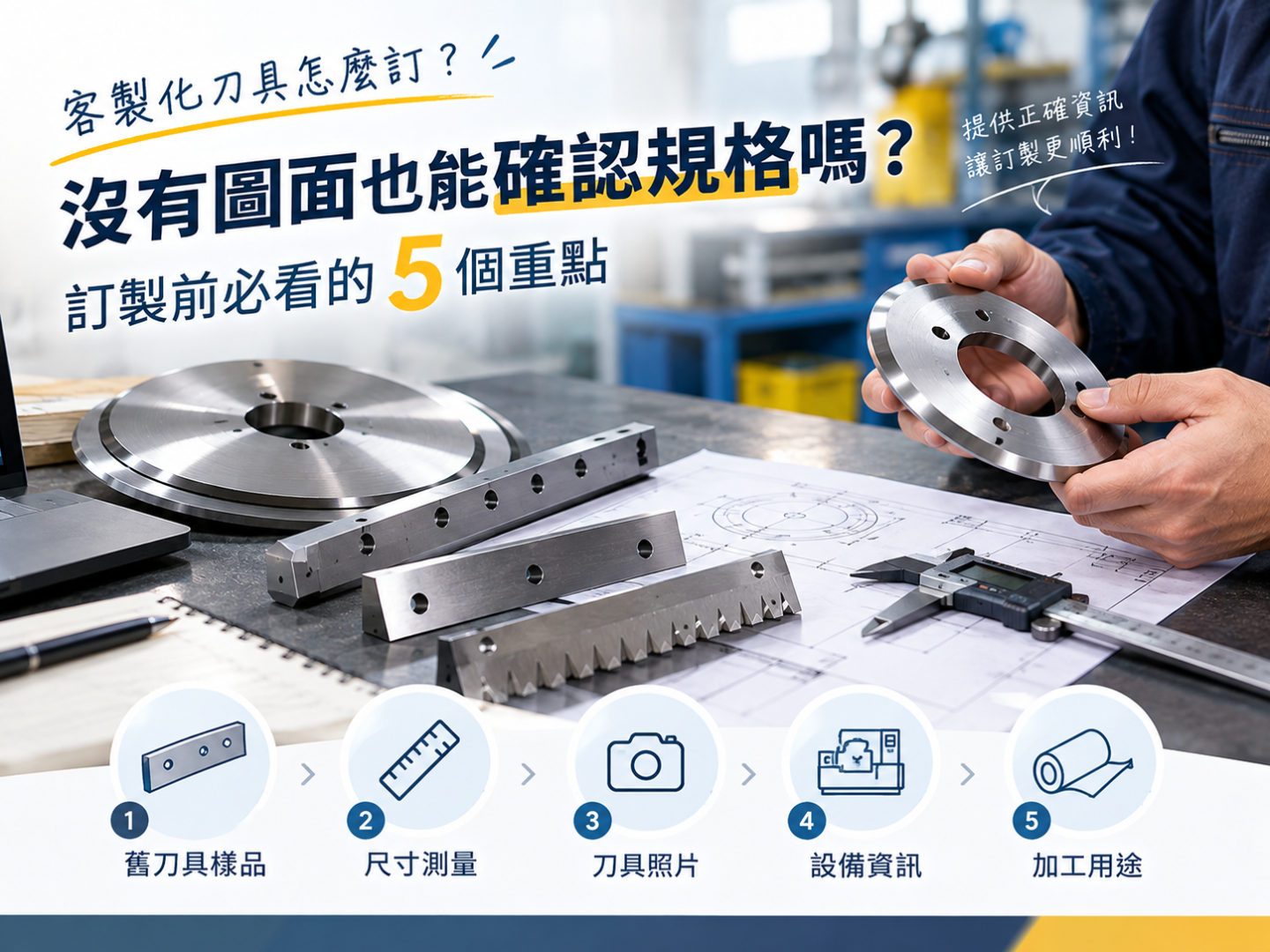
This article outlines 5 key points to consider before ordering custom industrial knives, helping you prepare the necessary information in advance and making the specification-confirmation process more efficient.
Confirm Where the Knife Is Used Before Measuring Its Dimensions
When a replacement knife is needed, many people naturally start by measuring its length, width, and thickness.
Dimensions are certainly important, but before confirming the specifications, there is another fundamental question:
What machine is the knife used on?
Knives that look similar may require completely different designs depending on the equipment they are installed on.
For example, some knives are used on packaging machinery, while others are installed on bag-making machines. Some are used for continuous material cutting, while others are designed for perforating, slitting, or specialized processing.
- Mounting method
- Hole pattern
- Installation position
- Actual application
- Equipment name
- Machine model
- Knife installation position
- Primary knife application
- Material being processed
If the machine model is unknown, there is no need to worry. Explaining where the knife is installed in the production process and what operation it performs can also provide valuable information for the manufacturer.
For a knife manufacturer, knowing what the knife is designed to do is often more useful for an initial assessment than having only a set of dimensions.
Without a Drawing, the Existing Knife Is Your Most Important Reference
Many factories operate machinery that has been in service for years, and the original technical documentation may have been lost.
In such cases, the existing knife itself can be an important reference for determining the required specifications.
- Overall profile
- Length and width
- Thickness
- Number of mounting holes
- Hole locations
- Round or specially shaped holes
- Cutting-edge position
- Special notches or structural features
For circular knives, the outside diameter, inside diameter, and other structural features can also be checked.
Therefore, if the original knife is still available, it is recommended not to discard it prematurely. Even if it can no longer be used, it may serve as an important reference sample for reproducing the required specifications.
Some knives used in specialized equipment are not standard off-the-shelf products. In particular, machinery that has been in operation for many years may use knives originally designed specifically for that equipment.
In these situations, an existing knife can often provide much more useful information than a simple written description.
How to Measure a Knife: 6 Key Dimensions to Check
If no complete drawing is available and an original knife sample cannot be provided, you can start by collecting the basic dimensions.
The required measurements vary depending on the knife type, but the following six dimensions are commonly used as basic reference data.
1. Length
Length is primarily used to determine the overall dimensions of straight or elongated knives.
For example, certain cutting knives, sealing & cutting knives, and special-purpose machine knives may require the total knife length to be confirmed.
When measuring, be sure to check whether the measurement includes any special features at either end and identify the actual mounting area.
2. Width
Knife width affects both the installation position and the cutting or processing area.
Two knives may have the same length but different widths, making them unsuitable for the same machine. Therefore, it is not recommended to provide only the length when confirming specifications.
3. Thickness
Thickness is another dimension that is easily overlooked.
Different machines may have specific requirements for the knife holder, mounting slot, or clamping structure. If the thickness is incorrect, the knife may not fit properly even when the other dimensions are correct.
4. Outside Diameter
Circular knives generally require the outside diameter (OD) to be confirmed.
For circular cutting knives and slitting applications, the outside diameter can directly affect the effective cutting range, so it should be measured as accurately as possible.
5. Inside Diameter
Some circular knives are mounted through a center bore, making the inside diameter (ID) an important specification.
In addition to the diameter, the actual shape of the bore should also be checked. Some knives have specially shaped mounting bores rather than a simple round hole.
6. Hole Pattern
For elongated knives and custom-specification knives, the hole pattern can be particularly important.
- Number of holes
- Center-to-center distance
- Hole locations
- Hole shape
Two knives may have exactly the same external profile but still be incompatible with the same machine simply because their hole patterns are different.
Therefore, dimensional verification is not simply about “measuring the size.” It is about identifying the dimensions that affect actual installation and operation.
A Clear Photograph Can Often Be More Useful Than a Written Description
When customers inquire about custom-specification knives, a common situation is to describe the knife only in words:
“It’s a long knife.”
“There are several holes on it.”
“I think it is used for cutting.”
While these descriptions can provide an initial reference, they are usually not sufficient to fully understand the knife.
If no drawing is available, providing clear photographs is highly recommended.
Professional photography equipment is not necessary. A smartphone is sufficient as long as the knife is photographed in a well-lit environment. However, it is recommended to provide photographs from several different angles, including:
- Front view
- Back view
- Side view
- Close-up of the cutting edge
- Hole locations
- Special structural features
If possible, place a ruler or measuring tool next to the knife so that its approximate scale can be more easily identified.
Photographs are not intended to replace precise measurement. Their purpose is to help the manufacturer understand the knife's overall geometry and structure.
For knives with special notches, irregular profiles, or complex hole patterns, photographs from multiple angles can significantly reduce misunderstandings during technical communication.
Don't Provide Only the Dimensions—Specify the Material Being Processed
Two knives with similar appearances may have very different requirements depending on the material they are designed to process.
- Plastics
- Paper products
- Textiles
- Packaging materials
- Films
- Food processing
- Wood
- Other industrial materials
Different materials have different processing characteristics. Therefore, when ordering a custom knife, it is important to specify not only the dimensions and profile but also the actual application and material being processed.
- Cutting
- Slitting
- Punching / Perforating
- Sealing & Cutting
- Perforation / Tear-off Cutting
- Granulating
- Crushing
This information helps the manufacturer better understand the knife's operating conditions.
When ordering a custom knife, therefore, it is best to provide both the dimensions and the intended application, rather than sending only a dimension sheet.
Can a Custom Knife Really Be Manufactured Without a Drawing?
The answer is not simply “yes” or “no.”
Whether the specifications can be confirmed depends on whether the available information is sufficient.
A complete drawing is, of course, an important manufacturing reference. However, if no drawing is available, the following information can also help with specification verification:
Existing Knife Sample
This is one of the most useful references because the original profile and dimensions can be directly examined.
Photographs of the Existing Knife
Multiple photographs from different angles can help reveal the overall structure.
Basic Dimensions
- Length
- Width
- Thickness
- Outside diameter
- Inside diameter
- Hole pattern
Equipment Information
Machine information can help determine the knife's possible mounting method and application.
Processing Material and Application
Even if the available information is incomplete, knowing the material being processed and the knife's intended application can provide an important reference for determining the appropriate specifications.
Therefore, not having a complete drawing does not necessarily mean that a custom knife cannot be manufactured.
The key is to organize all available information and use it as the basis for further technical verification.
Why Can't Special-Specification Knives Be Manufactured Based on a Photo Alone?
This is an important point to understand.
Although photographs are extremely useful, they are affected by perspective distortion and scale differences and therefore generally cannot replace actual dimensional measurements.
For example, two holes that appear identical in a front-view photograph may actually have different diameters. Distances shown in a photograph may also be distorted depending on the shooting angle.
Photographs are therefore best used to verify:
- Overall profile
- Structural features
- Cutting-edge position
- Number and arrangement of holes
- Special design features
Precise dimensions, however, still need to be confirmed through actual measurement.
This is why, when ordering a custom knife, it is best to provide:
Photos + Dimensions
If these are accompanied by an existing knife sample or equipment information, the available reference data becomes much more complete.
Organizing Your Information Before Ordering Can Reduce Repeated Clarifications
One of the biggest differences between a custom product and a standard product is the need for specification verification.
If the initial inquiry simply says:
“I need a knife made like the original one.”
without any additional information, multiple follow-up questions about dimensions, application, and equipment may be required.
On the other hand, if you can provide the following information with your initial inquiry:
Knife photos + Basic dimensions + Equipment information + Processing application
the requirements can usually be understood much more efficiently.
This not only improves communication efficiency but also reduces the risk of misunderstandings caused by incomplete information.
This is especially important when production equipment is already shut down and waiting for a replacement component. Preparing complete information at an early stage can help reduce the time spent on repeated technical confirmations.
Every Custom Knife Starts with Understanding the Application
Customizing an industrial knife is not simply a matter of “copying an old knife and making another one.”
The real first step is to understand the knife's application and the requirements of the equipment.
The next step is to verify the profile, dimensions, and mounting method based on the available information.
If a drawing is available, provide it. If not, an existing knife, photographs, and dimensional information can all serve as useful references.
For machinery with special specifications, every detail can matter.
The location of a mounting hole, a special notch, or even the position of the cutting edge can affect actual installation and operation.
Therefore, spending some time organizing the necessary information before placing an order can make the subsequent specification-confirmation process much smoother.
Conclusion: The More Complete the Information, the More Efficient the Customization Process
When a special-purpose industrial knife needs to be manufactured, not having a drawing does not necessarily prevent the specifications from being confirmed.
If the original knife is still available, it can serve as an important reference. If no sample is available, clear photographs and basic dimensions can also be provided.
In addition, be sure to specify the equipment, processing material, and intended application.
The value of an industrial knife is not determined solely by its appearance and dimensions. More importantly, it must be correctly installed on the equipment and meet the actual processing requirements.
The next time you need to reproduce or replace a custom knife, start by organizing the information you already have:
Existing knife + Photos + Dimensions + Equipment information + Processing application
These five types of information provide a practical starting point for confirming custom knife specifications.
Huang-Qi Co., Ltd. | Custom Industrial Knives Based on Your Equipment Requirements
Huang-Qi Co., Ltd. specializes in manufacturing industrial machine knives and custom cutting blades, helping customers verify knife specifications and manufacturing requirements according to their equipment and application needs.
Our products are used across a wide range of industries, including plastics, paper and corrugated products, textiles, packaging, bag making, and other industrial processing applications.
For special-specification knives or replacement knives for legacy machinery, customers can provide:
- Photos of the existing knife
- Existing knife samples
- Basic dimensions
- Equipment information
- Processing application
- Available drawings or technical documentation
Providing complete reference information helps us better understand your requirements and proceed with technical specification verification and custom knife development.

